COP30, or why cities and science are key to climate action
COP30’s key negotiated outcome fell short of including a roadmap for fossil fuel transition. The ability of petrostates and their allies to counter substantial attempts to tackle the main cause of global warming also implies blocking scientific assessments that challenge their political and economic positions. Contrary to petrostates, cities do not have power in the official negotiations, despite their key potential in an increasingly urbanized world. The spotlight now goes to the IPCC Special Report on Climate Change and Cities to be published in 2027 and to the geopolitical tensions and climate backlash that may seek to undermine this global scientific assessment.
Multilateralism in general and intergovernmental climate negotiations in particular are thorny domains by nature. While fossil fuels are widely acknowledged as the largest contributor to global warming, no Conference of the Parties (COP) decision since its very inception in 1995 has ever explicitly called out all fossil fuels. As a reminder of the inherent complexity of international politics, it was only two years ago at COP28 in Dubai, under the presidency of a petrostate such as the United Arab Emirates, when for the first time countries explicitly agreed to transition away from fossil fuels.
With COP30 taking place in Brazil, breaking the recent chain of repressive petrostates as host countries, many hoped that the ‘COP of truth’, as defined by President Lula, could provide the adequate setting to take the urgently required bold decisions to address the increasing impacts of climate change. Yet the main outcome text of this year’s edition, ‘Global Mutirão’ (i.e. a Portuguese word for collective efforts that draws on the Indigenous Tupi-Guarani languages), did not reaffirm Dubai’s landmark language and did not include the increasingly acclaimed roadmap for phasing out fossil fuels. All this happened despite the clear political will by the Brazilian host to act as an international leader and catalyze a new era of climate action. After all, the country took the highly symbolic decision to host the UN conference in Belém. Geographically and historically recognized as the gateway to the Amazon, the world’s largest rainforest, Belém welcomed the COP30 delegates in a region that powerfully reminds that nature conservation and climate action are two sides of the same coin.
Disagreements among countries, for instance among global North and global South on the equally urgent need for climate finance, abound. Yet any attempt to tackle the main cause of global warming is systematically countered by major fossil fuels producers that are reluctant to accelerate the energy transition. In the last COP, the proposal of a roadmap for fossil fuel transition was included in the first draft of Belém’s key negotiated outcome, yet it did not prosper thanks to the opposition, among others, of the Arab group, chaired in Belém by the petrostate Saudi Arabia. Likewise, a selected group of petrostates supported by United States have recently blocked the Summary for Policymakers of the Global Environment Outlook 7, which is currently the most comprehensive scientific assessment of the environment. The summary, which is designed to distill the main findings into actionable policy recommendations, has been blocked by a small group of countries that did not want the scientific assessment to challenge their political and economic positions on fundamental contentious points such as the phase down of fossil fuels and repurposing of fossil fuel subsidies.
Since COP decisions are taken by consensus, countries committed to establishing a roadmap for the energy transition are joining forces away from the institutional architecture of the UN official negotiations. Such is the case of Colombia and the Netherlands, who rallied support in Belém around the celebration of the 1st International Conference for the Phase-Out of Fossil Fuels in 2026. This initiative, which is not part of the COP30 negotiated outcomes, is testament to the shaky times of contemporary global governance. As geopolitical tensions and climate backlash arise, only voluntary efforts gathering like-minded countries can, unfortunately, thrive in a multilateral system gridlocked by entrenched countries who place national interest before global challenges requiring international cooperation.
However, the members of such “coalition of the willing” are not alone. They have deeply engaged allies beyond the corridors gathering the official negotiators. A promising one of them is cities and subnational governments more broadly, who have brought their voices to the United Nations Framework Convention on Climate Change (UNFCCC) policy processes since the first climate COP in 1995 through the Local Governments and Municipal Authorities (LGMA) Constituency. As governmental actors with political legitimacy and experience on the ground, cities are at the center of both mitigation and adaptation to climate change. Accounting for 67-72% of global greenhouse gas emissions, cities have demonstrated to be, in overall terms, more ambitious than their national counterparts when defining emissions reduction targets. Likewise, as governments of proximity to their communities, cities play an essential role in protecting their population, infrastructure, and ecosystems from the growing effects of global warming, with adaptation finance being heavily reliant on public sector resources.
Several countries have already taken good note of their internal allies. Seventy-seven of them, plus the European Union, have joined the Coalition for High Ambition Multilevel Partnerships (CHAMP) for Climate Action, committing to integrating subnational climate action into national climate policy. Likewise, the last round of Nationally Determined Contributions (NDCs 3.0), which are the national plans developed by countries to reach the Paris Agreement’s objectives, have seen a clear increase in the inclusion of subnational climate action. Yet, despite recent achievements, the key role and contribution of cities and subnational governments is still far from being formally recognized in the institutional architecture of climate governance. In Belém, despite the support of friendly countries, the call to establishing a dialogue on multilevel climate action could not be retained in the final version of Global Mutirão. The institutionalization of the participation of subnational governments in the UNFCCC policy processes beyond their current status as an observer constituency is still pending, blocked by official negotiations where national interests, invoking sovereign prerogative, can, at the same time, dismantle collective efforts to phase out fossil fuels and tackle the root causes of global warming.
Cities might have in the near future an unprecedented platform to bring their voices into global climate multilateralism. Following a decision in 2016, the Intergovernmental Panel on Climate Change (IPCC) has decided to produce a first-ever Special Report on Climate Change and Cities. The report, which is currently being prepared by experts from across the world, will provide a global scientific assessment of the relationship between cities, the state of climate change, and climate action. It will be published in 2027, one year before the conclusion of the next Global Stocktake, which will provide an essential evaluation of collective progress towards the Paris Agreement’s objectives, outlining guidance for countries. The IPCC special report may be instrumental in illuminating the ongoing efforts of cities in adaptation and mitigation, and the widening gaps that need to be addressed to bridge their key potential. Like with the Summary for Policymakers of the Global Environment Outlook 7, cities and their allies may well start to prepare for those countries that may not want the scientific assessment to challenge their political and economic positions.
Key words: COP30, cities, climate, multilateralism, global warming, IPCC, fossil fuel, UN, Brazil, Belém, environment, UNFCCC
E-ISSN 2014-0843
All the publications express the opinions of their individual authors and do not necessarily reflect the views of CIDOB or its donors
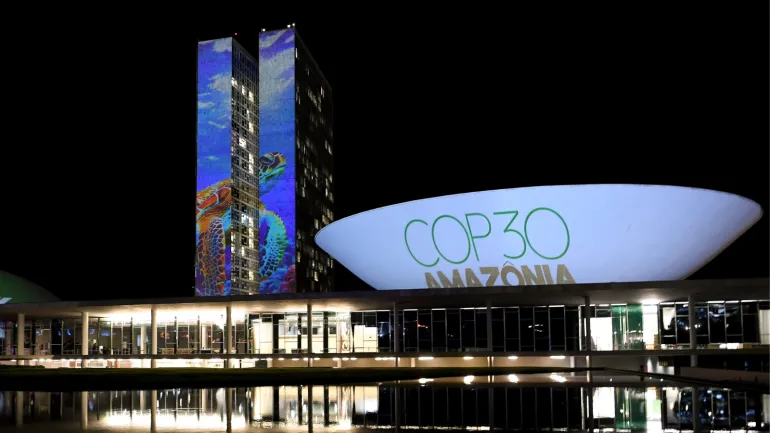
Image: © Agência Senado from Brasilia, Brazil, via Wikimedia Commons