Has the EU lost the plot? Matching internal reforms with external ambitions
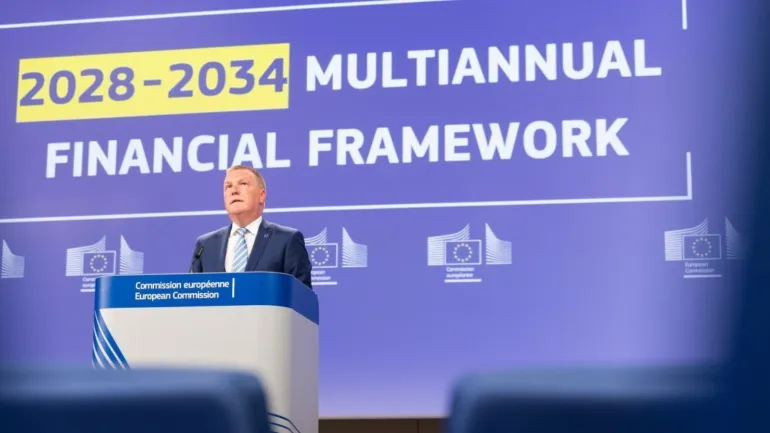
As the EU hammers out its next Multiannual Financial Framework, it stands at a pivotal moment: can it match its domestic reforms with its external ambitions in an increasingly unpredictable world? With big changes on the table and both unity and division at play, the burning question is whether the EU will genuinely back its promises with action, or risk losing its way as a regional and global force.
Last July, the European Commission released its proposal for the next Multiannual Financial Framework (MFF) that will define the EU’s future strategy and priorities for the 2028-2034 period. With the negotiation process now open for the coming two years, European Union institutions, Member States and civil society are already fraught and pushing for amendments. Beyond classical grievances between frugal (i.e., budget-tight) and non-frugal Member States, and political plays between the European Parliament and European Commission, the EU faces a key question: can it effectively reconcile its internal priorities with its external ambitions? To some extent.
The proposed MFF attempts to respond to the EU’s push for a new era of European integration – notably following the publication of the Draghi, Letta and Niinistö reports – and aims to recalibrate towards four strategic priorities: competitiveness, security, resilience, and strategic autonomy. To advance its competitiveness and security objectives, the MFF establishes a new European Competitiveness Fund (ECF) worth €589.6 billion. By financing investments in innovations, secure supply chains, and strategic technologies in defence and in the digital and clean transition, the fund attempts to build towards a more integrated and forward-looking internal market.
In addressing resilience-building and social cohesion, the Cohesion and Common Agricultural Policy (CAP) face a radical overhaul: its budget would be reduced from 60% to 43% and its structure streamlined from 500 current programmes into 27 National Regional Partnership Plans. This transformation aims to enhance regional development, flexibility and Member States’ capacity to tackle future challenges. To promote the EU’s strategic autonomy and geopolitical standing, funding for external action under the new Global Europe Instrument (GEI) is increased to €215.2 billion (a 57% real-term increase). Similar to the cohesion and CAP, this fund would merge several existing programmes into six main regional envelopes, in an effort to increase mutually beneficial partnerships and the EU's global influence vis-à-vis other actors.
Pragmatically, the MFF puts forward policies that focus on key operationalisations. For instance, defence funds focus on arms procurement and capacity building; competitiveness and industry budgets aim to integrate the internal market; cohesion and CAP funds support regions and farmers, while external action focuses on international partnerships. Although all these policies are necessary, their interdependencies are currently not reflected across the MFF. Indeed, the current proposal lacks a framework that effectively emphasises the embedded complementarity between the EU’s domestic priorities and its geopolitical aspirations. Geopolitical engagement, for example, is no longer limited to foreign affairs but spans across all policy areas both in the internal and external spheres. As underscored in the previous Von der Leyen Commission, this reality has limited the EU’s external action to a reactive role, for instance towards Ukraine, blocked by Member States’ national interests despite an overwhelming global agenda. Today, the EU no longer has the luxury of procrastinating, as doing so risks undermining its objectives and agency.
To foster a comprehensive and whole-encompassing vision, the EU should proactively look to create more synergies within an overarching strategic and implementing framework. Only then can it efficiently allocate the budget needed to meet its ambitions. Resources will follow clarity of objectives. Practically, this will require a concerted effort at the institutional level – notably across the Commission Directorates – to increase communication and discussions that can effectively identify points of convergence.
At a policy level, the proposed MFF structure may already reveal some potential complementarities. The EU’s defence agenda could be matched with peacebuilding, regional cohesion and connectivity initiatives – for instance, within the European Peace Facility and cohesion policy – to account for the unintended risks that may arise from increased defence spending. This is particularly relevant in historically conflict-ridden contexts, such as the Western Balkans, where bulk defence spending and cooperation may exacerbate existing tensions and grievances. The proposed European Competitiveness Fund could be more explicitly aligned with the Global Europe Instrument’s focus on strengthening geoeconomic partnerships through private sector investments. For example, securing critical raw materials and building secure supply chains will require better alignment between domestic policies and economic diplomacy.
Cohesion and CAP policies – despite their structural changes – could be more closely aligned with democracy-building and rule of law initiatives. This is especially salient for Member States and accession countries that are at risk of, or undergoing, democratic backsliding. A clearer interrelation may sustainably promote social cohesion, empower citizens and civil society to build more resilient democracies. Finally, the EU should act with caution in its migration management, notably with respect to its external migration policies. Here, external migration policy has become the EU’s foreign policy tool of choice in reshaping EU-Africa relations. Yet, clearer delineations of this strategy within the GEI and independent migration funds (both at EU and Member State levels) – particularly in border enforcement – are necessary to limit conditionalities, instrumentalizations, and ensure legal compliance, transparency and accountability.
Ultimately, the EU is at a crossroads. The key challenge it faces over the next two years will be whether it can effectively reconcile its aspirations with its capabilities – and translate its promises into action. Whether the EU will be willing to put the money where its mouth is, will determine its domestic and global role for the coming decade. The stakes are high, and failing risks endangering the EU’s existence as a project and the values it claims to stand for.
Key words: Multiannual Financial Framework, European Union, EU’s external action, EU integration, Global Europe Instrument, cohesion, CAP, budget
E-ISSN 2014-0843
All the publications express the opinions of their individual authors and do not necessarily reflect the views of CIDOB or its donors
Image: © European Union, 2025