Armenia may be turning West, but EU membership is a long way off
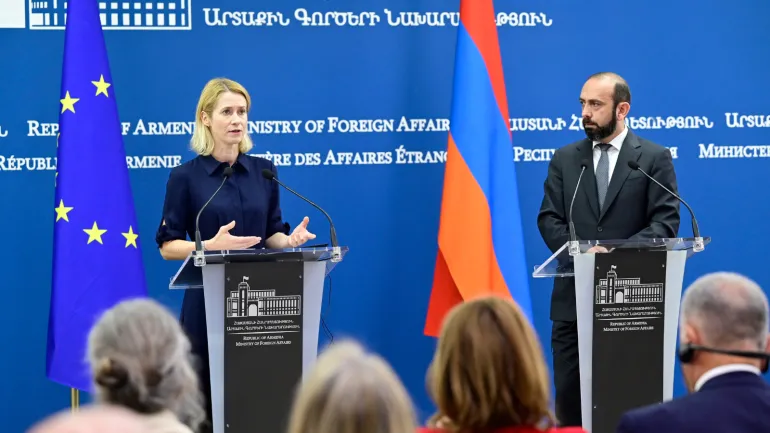
Armenia’s break with Moscow and warmer ties with Europe have fuelled talk of a looming EU candidacy, but reality is far more constrained. Yerevan is indeed edging West – even passing a law urging the government to launch an EU application – yet it remains bound to Russia’s security and economic structures. Brussels, meanwhile, shows little appetite for another enlargement round. Armenia may be recalibrating its foreign policy, but EU membership is distant, and integration without accession remains the only realistic path for now.
For months, signs of Armenia’s decoupling from Russia and its growing closeness to the West have fed a distorted narrative – one in which Russia is written off from the South Caucasus, and Armenia is seen as a soon-to-be EU candidate country. Armenia has been Russia’s longstanding ally for decades, but relations have soured, especially since the second Karabakh war in 2020. Unhappy with Russia’s inability or unwillingness to defend Armenia, the Armenian government froze its membership in the Collective Security Treaty Organisation (CSTO), a Russia-led security structure. At the same time, anti-Russian sentiment grew among the population.
In a bid to diversify its foreign policy away from Moscow, Yerevan has been particularly keen to open a path to EU membership. In March 2025, the parliament approved a law initiated by civil society members that calls on the Armenian government to launch the process of EU accession. Senior officials, including those at the top level, regularly invoke the law and Armenia’s European aspirations. Even so, Armenia’s formal candidacy – let alone EU membership – is still a faraway prospect and relations with Russia remain a cornerstone of the country’s foreign policy.
The biggest obstacles on Armenia’s EU path
Despite being tied to Moscow since the fall of the USSR, Yerevan has also maintained increasingly warm relations with the EU. Yet, whenever it tried to deepen integration with Brussels, Armenia’s closeness to Moscow has been an obstacle. For instance, in 2013 Armenia was ready to sign an Association Agreement (AA) in the framework of the EU Eastern Partnership programme, but eventually gave in to Russian pressure and joined the Eurasian Economic Union (EAEU) instead.
Today, EAEU membership constitutes the main formal obstacle on Armenia’s path towards EU membership, not just for political reasons – Russia being the EAEU’s major economy – but also because they are two different, hence incompatible zones of free trade where members align on external tariffs and duties. The Armenian government is obviously aware of this incompatibility. Asked by the author during a conference Q&A, Prime Minister Pashinyan said, “Of course, we know that we cannot join the EU if we are members of the EAEU. At some point, we'll have to make a choice. But it will be Armenian citizens, with the mediation of the government and parliament, who will have to choose”.
Armenia appears to be in no rush to make this complex decision. So far, Armenian officials have repeatedly claimed their country is not going to renounce EAEU membership, also given the importance of Russia trade-wise: Moscow is Yerevan’s top trading partner, and in 2024, a record year in Russia-Armenia trade, it accounted for over 41% of Armenia’s foreign trade, compared with the EU’s 7.7% share. The degree of Russia’s penetration into the Armenian economy goes beyond trade: Russia also sells the bulk of Armenia’s gas at a discounted price and owns other key energy and transport infrastructure, such as Electric Networks of Armenia and the South Caucasus Railway.
Another obvious obstacle is Armenia’s CSTO membership, which would be at odds with NATO membership of most EU members. Yerevan froze its CSTO membership following complaints over a lack of protection during Azerbaijan’s incursions into Armenian territory that should have triggered the clause of mutual defence ingrained into Article 4 of the CSTO Treaty. However, the country is not considering withdrawing from the organisation.
More broadly, Armenia is building a diverse portfolio of external relations, including Russia and other Eurasian states, while seeking greater integration with the EU. In 2025, it officially applied for membership in the Shanghai Cooperation Organisation, which is often considered as one of Russia and China’s tools to push alternative – read post-Western – visions of global order. While Armenia’s bid was blocked, the move raises questions about the solidity of its EU aspirations. In fact, Armenia’s desire for a multi-vectoral foreign policy reflects only its economic dependencies and the realities of the region where it belongs.
Is the EU fit for enlargement?
Another elephant in the room is Brussels's lack of real desire to start another enlargement process. The Union is ready to deepen cooperation with Armenia. It has demonstrated a remarkable sense of adaptation when, in 2013, then-president Sargsyan announced his country would join the EAEU instead of signing the AA with the EU: Brussels came up with the Comprehensive and Enhanced Partnership Agreement (CEPA), signed in 2017, which still allowed Armenia to receive political and financial support for its internal reforms and development.
Yet, from private conversations with EU officials as well as public declarations, there seems to be little appetite for starting another challenging and politically sensitive enlargement round with Armenia, which would also considerably deepen the already severe EU-Russia crisis. Such a process would add to the already complex enlargement scenario after 2022, when Ukraine, Moldova, and Georgia applied for EU membership.
If, on the one hand, it is true that granting Ukraine and Moldova candidate status – the process is currently frozen in Georgia due to the democratic backsliding – gave new impetus to enlargement, it also revived grievances from countries in the Western Balkans that have been patiently awaiting full membership for years and resented perceived favourable treatment to the Eastern European countries due to Russia’s aggression.
Ukraine’s eventual entry would have a tremendous impact on the EU’s cohesion and agricultural policies, not to mention the added security-related challenges. But even smaller countries like Armenia and Moldova would dramatically affect the Union’s foreign policy perspective and decision-making processes. Such a consideration informs the opinion of several academics who maintain that in its current form, the EU is not ready to welcome new members.
Indicating it is aware of this issue, the EU was set to release the Fit for Enlargement strategy before the end of 2025, but at the time of writing it has not done so yet. Even so, radical and difficult changes are needed before the institutions can adjust to an enlarged EU, and the strategy is unlikely to be resolutive in this sense.
Integration without membership
The Armenian government is right to promote a diversified foreign policy, maintaining cooperation with Moscow while carefully avoiding becoming overly reliant on Russia – as it has been in the past – and boosting cooperation with the EU. Peace with its former long-standing enemy, Azerbaijan, and EU cooperation are opening new economic opportunities for Armenia in terms of connectivity and trade. At the same time, Yerevan cannot ignore its economic dependence on Moscow. Even so, emphasising a possible EU candidacy is tricky and politically dangerous as it could raise unrealistic expectations among citizens and backfire if those expectations are not met.
At present, there is no credible EU membership option on the table, even if Brussels is keen to deepen its links with Armenia. On 2 December 2025, a new Strategic Agenda for the EU-Armenia Partnership was adopted. Building on CEPA, but without mentioning the membership perspective, the Strategic Agenda adopts a cooperation roadmap in response “to Armenia’s expressed ambition to strengthen ties with the European Union”, focused on connectivity and political and economic reforms. Notably, it also opens a dialogue on visa liberalisation to promote people-to-people exchanges. Furthermore, Armenia’s government has asked the EU for help countering possible malign interference in the June 2026 parliamentary elections.
While this may fall short of meeting the EU membership ambitions shared by some segments of Armenia’s civil society, it is a credible and pragmatic way to enhance EU-Armenia relations in the current period, marked by rapid changes and complexities in both the region and the EU.
Key words: Armenia, enlargement, EU, membership, Russia, integration, accession, South Caucasus, Pashinyan
E-ISSN 2014-0843
All the publications express the opinions of their individual authors and do not necessarily reflect the views of CIDOB or its donors
Image: © European Union, 2025